Cold roll steel VS Hot roll steel VS Galvanized sheet for metal door
how to choice what kind of steel will good to use for us, cold-rolled steel, hot-rolled steel, and galvanized steel are the three most common materials. This article will explain their differences in terms of material appearance, processing technology, material properties, cost differences, application fields, and specific applications in metal doors, helping everyone understand why some steel doors use cold-rolled steel while others use galvanized steel.
I. Differences in Material Appearance
Cold-Rolled Steel
Surface Features: Cold-rolled steel sheets are rolled at room temperature, producing a smooth, flat surface with high gloss and no oxide skin.
Color: Typically exhibits a silver-gray color with a metallic luster and a fine texture.
Applications: Suitable for products that require high surface quality and precision, such as car exteriors, home appliance casings, and precision instruments.

Hot-Rolled Steel
Surface Features: Hot-rolled steel sheets are rolled at high temperatures, resulting in a rougher surface with common oxide skins and rolling marks.
Color: Usually appears dark gray or blue-gray, a result of high-temperature oxidation.
Applications: Commonly used for building structural materials, bridge materials, ship materials, and other areas that require high strength and relatively lower surface smoothness.

Galvanized Steel
Surface Features: Covered with a layer of galvanized zinc, the surface exhibits water ripple patterns or crystalline textures, giving it a unique texture.
Color: Typically bright silver-white, with a glossy surface.
Applications: Due to its excellent corrosion resistance, widely used in outdoor buildings, home appliance casings, ventilation ducts, etc.

II. Differences in Processing Technology
Cold-Rolled Steel Processing
Pickling: Removes oxide skin from hot-rolled steel surfaces, resulting in a clean surface. Cold Rolling: Steel plates are rolled at room temperature to achieve the desired thickness and surface quality.
Annealing: Eliminates the hardened parts from processing, improving material performance.
Leveling: Enhances the flatness and smoothness of the steel sheet.
Subsequent Processing: Includes coating, shearing, packaging, etc., as needed

Hot-Rolled Steel Processing
Heating: Steel billets are heated above the recrystallization temperature.
Rolling: Rough and finish rolling at high temperatures to achieve desired dimensions. Cooling: Controls cooling temperatures to achieve required performance characteristics. Straightening and Finishing: Ensures the flatness and dimensional accuracy of the steel sheet.
Inspection and Storage: Quality inspection followed by storage.

III. Differences in Material Properties
Hot-Rolled Steel
High strength and toughness: Suitable for steel structural components that can withstand significant loads.
Good plasticity: Low deformation resistance at high temperatures, easy to process.
Rough surface: Presence of oxide skin requires further processing for high-surface-demand products.

Cold-Rolled Steel
High dimensional accuracy: Uniform thickness and good surface quality.
Stable mechanical performance: After annealing, possesses good plasticity and ductility.
Good processing performance: Suitable for precise operations like stamping and stretching.

Galvanized Steel
Excellent corrosion resistance is the primary advantage.
Attractive surface: Can be directly used for appearance parts or as a base material needing coating.
Good processing performance: Strong adhesion of the zinc layer does not affect subsequent operations like stamping and bending.

IV. Cost Differences
Due to differences in processing technology, the production cost of cold-rolled steel is higher than that of hot-rolled steel, and galvanized steel, which includes an additional galvanizing process, is priced higher than both.
So Galvanizing > cold rolled steel > hot rolled steel
V. Differences in Application Fields
Hot-Rolled Steel: Suitable for ship materials, bridge materials, building structural materials, and other fields requiring high strength and toughness. Cold-Rolled Steel: Extensively used in automotive manufacturing, home appliance products, office equipment, and other areas demanding high surface quality and precision. Galvanized Steel: Mainly used for building exterior walls, roofs, home appliance casings, ventilation ducts, and other environments requiring corrosion resistance.
VI. Applications in Metal Doors
In the manufacturing of metal doors, material selection directly impacts the product quality and lifespan:
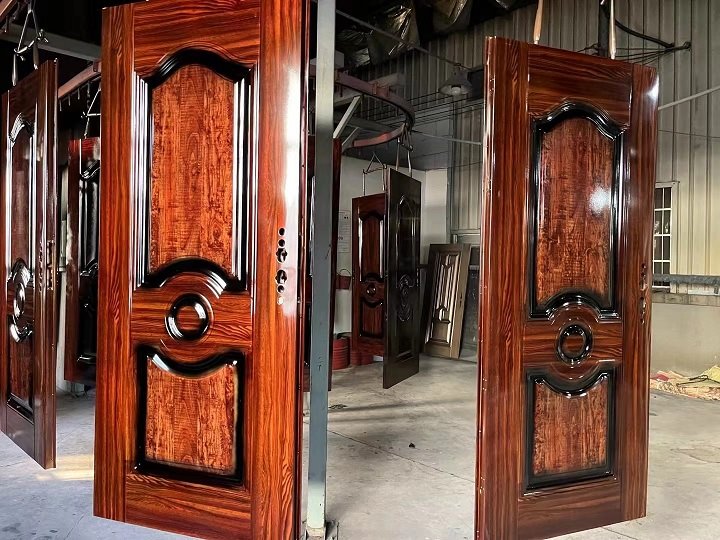
Cold-Rolled Steel Doors: The smooth, flat surface of cold-rolled steel makes it easy for painting and surface treatments, improving the appearance quality of finished doors. Suitable for interior doors or situations with high aesthetic requirements.
Galvanized Steel Doors: In humid or corrosive environments, such as outdoor doors and garage doors, galvanized steel, with its corrosion resistance, can extend the door’s life and reduce maintenance costs.
Conclusion
After understanding the differences between cold-rolled steel, hot-rolled steel, and galvanized steel, you should be equipped to make informed material choices. Selecting the appropriate material based on the product’s usage environment and performance requirements will ensure optimal cost-efficiency and effectiveness.
All TongYu steel door make by cold rolled steel and Calvanized steel. very good quality.